
keletal trailers and flatbed semi trailers are both widely used in container logistics.
At first glance, they may appear similar because both can be equipped with container twist locks. However, their frame structures, operating flexibility, tare weight and typical cargo applications are different.
Understanding these differences helps transport companies select the correct trailer for their routes and cargo.
What Is a Skeletal Trailer?
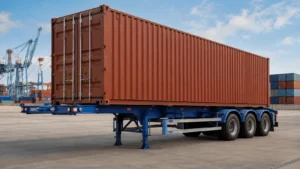
A skeletal trailer, also called a container chassis trailer, is primarily designed for transporting shipping containers.
Instead of a complete loading platform, it uses a strong open frame with twist locks positioned to support the container corners.
Its main components include:
- Longitudinal frame beams
- Cross-members
- Container twist locks
- Kingpin assembly
- Axles
- Suspension
- Landing gear
- Brake and electrical systems
The container itself forms the main cargo-carrying body during transportation.
What Is a Flatbed Semi Trailer?
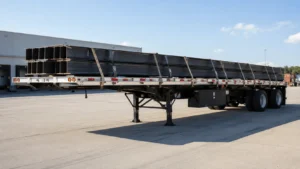
A flatbed semi trailer has a complete loading platform.
It may transport:
- Containers
- Steel
- Timber
- Pipes
- Machinery
- Building materials
- Palletized cargo
- Oversized items
When equipped with twist locks, it can also transport standard shipping containers.
Structural Difference
The main difference is the platform.
Skeletal Trailer Structure
A skeletal trailer has an open chassis design with no complete deck.
This generally results in:
- Lower tare weight
- Simpler body structure
- Easier container positioning
- Less material usage
- Limited use outside container transport
Flatbed Trailer Structure
A flatbed trailer has a continuous loading platform supported by main beams and cross-members.
This provides:
- Greater cargo flexibility
- Support for loose or non-containerized cargo
- More securing positions
- Higher tare weight
- More complex platform construction
Cargo Flexibility
A skeletal trailer is mainly used for container transport.
It is suitable for:
- Port-to-warehouse transport
- Container yard operations
- Intermodal logistics
- Long-distance container transport
- Empty or loaded containers
A flatbed trailer can transport containers but can also carry many other cargo types.
For transport companies that regularly switch between containers and general cargo, a flatbed trailer may offer greater flexibility.
Trailer Weight
Because a skeletal trailer does not have a full platform, it is generally lighter than a comparable flatbed trailer.
A lower tare weight may provide:
- Improved payload efficiency
- Reduced fuel consumption
- Lower material cost
- Easier handling
Actual trailer weight depends on axle configuration, frame reinforcement and local design requirements.
Loading and Unloading
Containers are usually loaded onto skeletal or flatbed trailers using:
- Port cranes
- Reach stackers
- Gantry cranes
- Container sidelifters
- Forklifts for empty containers where permitted
A skeletal trailer makes the container support points easy to access.
A flatbed trailer may require closer attention to platform height and twist lock location.
Twist Lock Configuration
Both trailer types can use twist locks.
The layout may support:
- One 20 ft container
- Two 20 ft containers
- One 40 ft container
- One 45 ft container
- Adjustable combinations
Buyers should confirm the intended container sizes before production because lock positions affect the frame design.
Maintenance
A skeletal trailer generally has fewer deck components, which can simplify inspection and maintenance.
Main inspection points include:
- Twist locks
- Frame welds
- Kingpin area
- Suspension
- Axle alignment
- Brake system
- Landing gear
- Electrical wiring
Flatbed trailers also require inspection of:
- Deck surface
- Cross-members
- Cargo hooks
- Platform reinforcement
- Floor corrosion or damage
Which Trailer Should You Choose?
Choose a skeletal trailer when:
- Most cargo is transported in containers
- Lower tare weight is important
- Port and container yard operations are frequent
- General cargo flexibility is not required
- Simple container logistics is the main application
Choose a flatbed semi trailer when:
- Containers and general cargo are both transported
- Steel, machinery or construction materials are common
- Side loading is required
- A continuous platform is necessary
- Flexible cargo applications are important
Conclusion
A skeletal trailer is a specialized and efficient solution for container transport. A flatbed trailer offers greater flexibility for mixed cargo operations.
The correct choice depends on cargo type, loading equipment, route conditions, legal requirements and long-term operating plans.