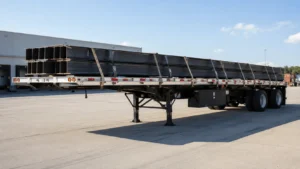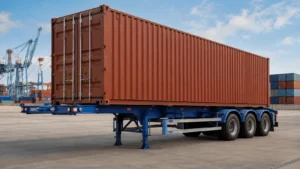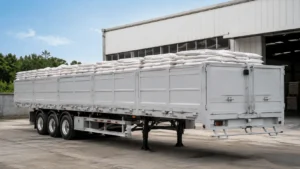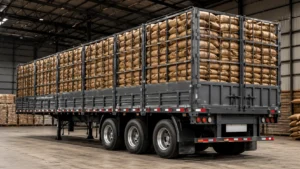

A flatbed semi trailer is widely used for transporting containers, steel, machinery, building materials and general cargo. This article explains its structure, applications and major configuration options.
Flatbed Semi Trailer: Structure, Applications and Key Features
A flatbed semi trailer is one of the most widely used transport vehicles in logistics, construction and international container transportation.
Its open platform provides flexible loading access from the rear, sides or top. Compared with enclosed trailers, a flatbed semi trailer can carry cargo with different shapes, dimensions and loading methods.
It is commonly used to transport shipping containers, steel products, pipes, timber, construction materials, machinery and packaged industrial goods.
What Is a Flatbed Semi Trailer?
A flatbed semi trailer consists of a main frame, open loading platform, axle system, suspension, brake system, landing gear and cargo-securing devices.
Because it does not have permanent side walls or a roof, the loading platform can accommodate oversized or irregular cargo.
A typical flatbed semi trailer may include:
- Main beams
- Cross-members
- Steel or wood platform
- Container twist locks
- Axles and suspension
- Landing gear
- Braking system
- Electrical lighting system
- Side protection and rear bumper
- Rope hooks and lashing rings
The final design should match the cargo weight, container dimensions and local road regulations.
Main Applications
Container Transport
Flatbed trailers can be equipped with twist locks for transporting standard containers.
Common container combinations include:
- One 20 ft container
- Two 20 ft containers
- One 40 ft container
- One 45 ft container where permitted
The twist lock positions must match the container corner castings.
Steel and Construction Materials
Flatbed trailers are frequently used for:
- Steel beams
- Steel plates
- Pipes
- Reinforcement bars
- Precast components
- Timber
- Construction equipment
Cargo-securing points should be positioned according to the size and weight distribution of these materials.
Machinery Transport
Smaller machinery and equipment may also be transported on a reinforced flatbed trailer.
However, very heavy or tall machinery is usually better suited to a low bed trailer because of loading height and concentrated weight.
Main Frame Structure
The main frame carries the majority of the cargo load.
Its design normally includes two longitudinal main beams connected by multiple cross-members. Reinforcement plates may be added at high-stress areas such as:
- Kingpin region
- Landing gear position
- Suspension mounting points
- Axle area
- Concentrated loading positions
Important structural factors include:
- Steel grade
- Beam height
- Upper flange thickness
- Lower flange thickness
- Web plate thickness
- Cross-member spacing
- Welding quality
The frame should be engineered according to the intended payload rather than selected only by appearance.
Platform Options
Common platform materials include:
Steel Plate Floor
A steel floor provides good durability and is suitable for many industrial cargo applications.
Patterned Anti-Slip Plate
An anti-slip surface helps improve safety during loading and unloading.
Wood Floor
Wooden flooring may be used for cargo that requires reduced surface damage or easier fastening.
Steel and Wood Combination
Some trailers combine steel structural sections with wood deck areas to balance strength and cargo protection.
Suspension Options
Mechanical Suspension
Mechanical suspension is simple, durable and widely used in rough road conditions.
It is commonly selected because of:
- Easy maintenance
- Strong load capacity
- Wide spare-parts availability
- Practical operating cost
Air Suspension
Air suspension offers smoother operation and better vibration control.
It may be selected for:
- Highway transport
- Sensitive cargo
- Markets with strict road requirements
- Operations requiring adjustable ride height
Cargo-Securing Devices
Because a flatbed trailer has an open platform, cargo restraint is extremely important.
Common securing accessories include:
- Twist locks
- Rope hooks
- Lashing rings
- Chain hooks
- Stake pockets
- Removable side posts
- Winches
- Tension belts
- Tool boxes for chains and straps
The securing method should match the cargo shape and transport route.
Advantages of a Flatbed Semi Trailer
A flatbed semi trailer offers several practical advantages:
- Flexible loading from multiple directions
- Suitable for containers and general cargo
- Easy forklift and crane access
- Adaptable to different cargo sizes
- Simple body structure
- Convenient maintenance
- Multiple customization options
Limitations
Flatbed trailers also have some limitations.
Cargo is exposed to rain, dust and sunlight unless protected by a tarpaulin. Cargo must also be secured carefully because there are no permanent side walls.
For loose, high-volume or weather-sensitive materials, another trailer type may be more suitable.
Conclusion
A flatbed semi trailer is a practical solution for container transport, construction materials, steel products and general industrial cargo.
Its performance depends on the frame design, platform structure, axle configuration, suspension and cargo-securing system. Buyers should provide detailed cargo and route information before confirming the final specification.